
Acne scarring affects approximately one in five people in the UK how has experienced acne as teens and adults, leaving lasting marks that can significantly impact confidence and self-esteem. If you have tried countless over the counter or prescribed creams and serums without seeing real improvement, you are not alone. The truth is that true acne scars—not just temporary red marks—require professional Treatment for Acne Scars to see meaningful results.
The good news? Treatment for Acne Scars have advanced significantly over the last 5-10 years, from laser resurfacing to regenerative therapies like PDRN (polydeoxyribonucleotide) or plasma, there are now multiple evidence-based options available. However, not every treatment works for every scar type or skin tone, which is why understanding your options is essential before committing to a treatment plan.
Why Do Acne Scars Form?
According to the NHS, scarring occurs when acne penetrates deep into the skin, damaging the tissue beneath. As the skin heals, it produces collagen—too little creates depressed scars, and too much creates raised scars.
Inflammatory acne, picking spots, and genetic predisposition all increase scarring risk. While preventing acne is preferable to treating scars, effective treatments do exist for those already living with scarring.
Types of Acne Scars
Before selecting a treatment, it is important to know what types of scars you may have, as different scars respond to different approaches.
Ice pick scars are narrow, deep holes that extend into the dermis, resembling small puncture wounds. These are among the most challenging scars to treat because of their depth. Many surface-level treatments simply cannot reach deep enough to make a difference.
Boxcar scars are round or oval depressions with sharp, defined edges. They typically result from inflammatory acne and vary in depth. Shallower boxcar scars respond well to resurfacing treatments, while deeper ones may require combination approaches.
Rolling scars create a wave-like, uneven skin texture caused by fibrous bands of scar tissue pulling the skin downward from beneath. These scars often require treatments that address both the surface and the underlying tethering.
Hypertrophic and keloid scars are raised rather than depressed. They occur when the body produces excess collagen during healing. These are more common on the chest and back and require different treatment strategies than atrophic (depressed) scars.
Post-inflammatory hyperpigmentation (PIH) refers to dark marks left after acne heals. Technically, these are not true scars—they are pigmentation changes that typically fade over time. However, they can persist for months or years without treatment.
What Treatment Options Are There?
Laser Treatment for Acne Scars
Laser therapy remains one of the most widely discussed options for acne scarring. It works by either removing outer skin layers (ablative lasers) or stimulating collagen production without removing tissue (non-ablative lasers).
How it works: Ablative lasers such as CO2 and Erbium vaporise thin layers of skin, prompting the body to produce new, smoother skin as it heals. Fractional lasers create microscopic treatment zones, leaving surrounding tissue intact for faster healing. Non-ablative lasers heat the underlying skin to stimulate collagen without surface damage.
Effectiveness: Research suggests laser treatment can improve acne scars by 50-90% in ideal candidates. However, results vary considerably depending on scar type, depth, and individual healing capacity. Multiple sessions—typically three to six—are usually required, spaced four to eight weeks apart.
Limitations: Laser treatment carries significant risks for darker skin tones. The heat energy can trigger post-inflammatory hyperpigmentation, potentially leaving skin darker than before treatment. This makes laser unsuitable or high-risk for many patients with Fitzpatrick skin types IV-VI. Additionally, ablative lasers involve considerable downtime—often one to two weeks of visible healing—and carry risks including prolonged redness, infection, and in rare cases, worsening scarring.
Cost: Expect to pay £300-600+ per session in the UK, with full treatment courses often totalling £1,500-3,600 or more.
For those considering laser, understanding both its potential and its limitations is crucial. We explore this in depth in our guide to laser treatment for acne scars.
PDRN (Polynucleotide) Treatment
PDRN—polydeoxyribonucleotide—represents a fundamentally different approach to scar treatment. Rather than destroying or removing tissue, PDRN works by stimulating the skin’s natural regenerative processes.
How it works: PDRN is derived from salmon DNA and contains purified nucleotide fragments that activate cellular repair pathways. When micro-injected directly into acne scars, PDRN stimulates fibroblast activity, promotes collagen synthesis, and enhances angiogenesis (new blood vessel formation). Research published in the Journal of Skin Stem Cell confirms that PDRN reduces inflammation and supports collagen remodelling in acne scar treatment.
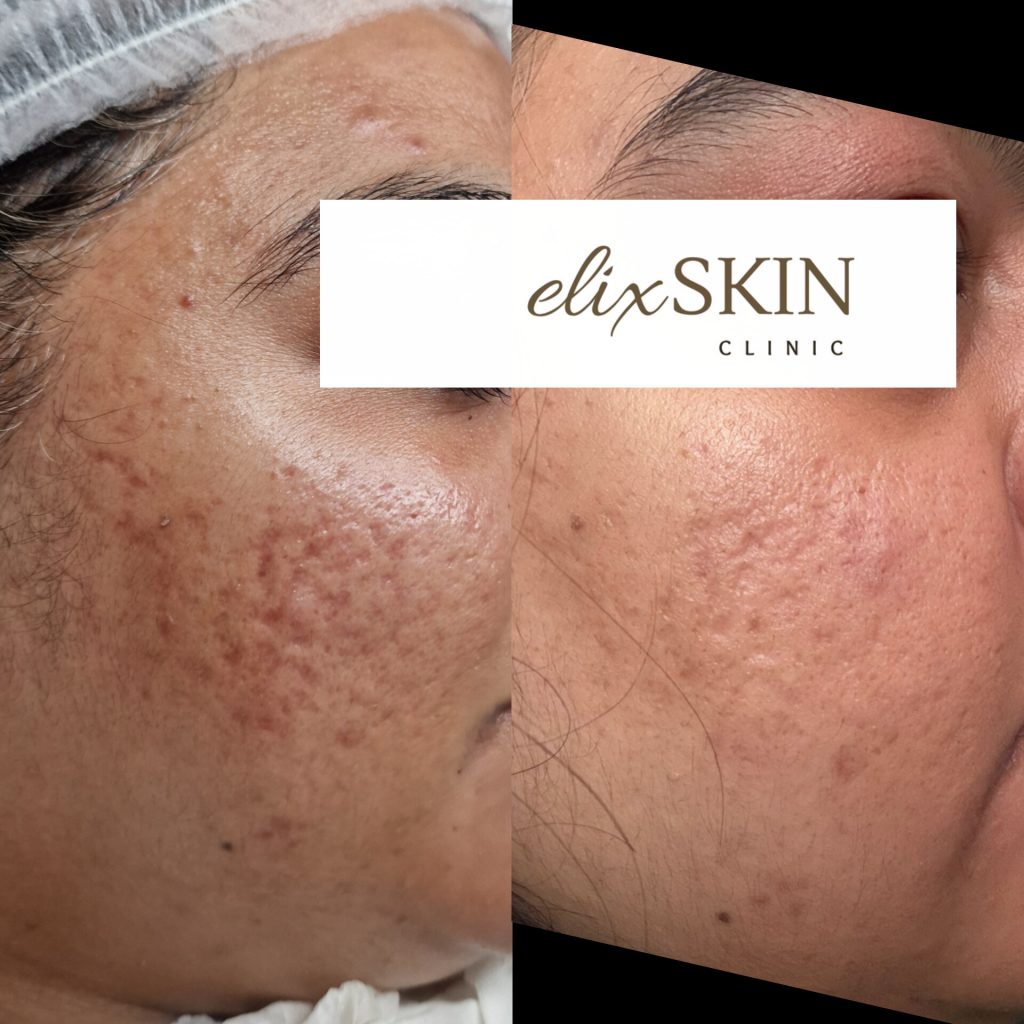
The Specialist Scar Treatment at Elixir Skin Clinic combines PDRN micro-injections targeted directly into individual scars with full-face polynucleotides to address all skin layers simultaneously. This dual approach ensures both localised scar treatment and overall skin quality improvement.
Effectiveness: Clinical studies indicate that 72% of patients see visible scar reduction after three PDRN sessions, with collagen density increasing by up to 34% in treated areas. Unlike laser, PDRN rebuilds tissue from within rather than ablating it, making it particularly effective for pitted scarring where tissue volume has been lost.
Key advantages: PDRN is safe for all skin tones with minimal risk of hyperpigmentation—a critical consideration for patients who cannot safely undergo laser treatment. Downtime is minimal, with most redness settling within 48 hours and skin fully recovered within five days. The treatment also benefits those with slow healing or low iron levels who may not respond well to more aggressive approaches.
Cost: Approximately £375 per session, with three sessions recommended for optimal results (approximately £1,125 total).
Microneedling
Microneedling creates controlled micro-injuries using fine needles, triggering the skin’s wound healing response and stimulating collagen production.
How it works: A device containing multiple fine needles punctures the skin at controlled depths, typically 0.5-2.5mm for scar treatment. This initiates a healing cascade that includes increased collagen and elastin production. When combined with growth factors, or clinical grade products, results may be enhanced.
Effectiveness: Studies show microneedling can improve acne scars by 30-70%, though multiple sessions (typically four to six+) are needed. It works best for shallow to moderate scarring and is generally less effective for deep ice pick scars.
Limitations: Results are gradual and may take six months or longer to fully appreciate. Deep scars often require combination treatment. While generally safe for darker skin tones, aggressive treatment can still trigger pigmentation changes.
Cost: £175-350 per session, with courses of four to six sessions common.
Subcision
Subcision releases tethered scars by breaking fibrous bands beneath the skin using a needle or blade. This allows scars to rise to the surface while triggering collagen production.
Effectiveness: Particularly effective for rolling scars, often combined with fillers or PDRN for enhanced results.
Limitations: Less effective for ice pick scars. Bruising common post-treatment.
Cost: £200-500 per session.
Which Is Best?
Laser Treatments May Not Always Be the Answer
Laser treatment is often presented as the gold standard for acne scars, but this reputation does not tell the whole story.
For patients with darker skin tones, laser carries substantial risks. The melanin in darker skin absorbs laser energy more readily, leading to burns, hyperpigmentation, or hypopigmentation (lightened patches). A 2023 review in the International Journal of Molecular Sciences noted that while laser can be performed on darker skin types, it requires significant expertise and carries higher complication rates.
Laser also struggles with deep ice pick scars. Because these scars extend deep into the dermis, surface resurfacing often fails to address them meaningfully. Many patients undergo multiple expensive laser sessions only to find their deepest scars unchanged.
Additionally, laser destroys tissue to prompt regeneration. For patients whose skin heals slowly—whether due to genetics, nutritional deficiencies like low iron, or underlying health conditions—this aggressive approach may not yield optimal results.
This is precisely where regenerative treatments like PDRN offer an alternative. By working with the body’s healing processes rather than against them, PDRN rebuilds tissue without the risks associated with ablation.
The Case for PDRN and Polynucleotides
PDRN treatment represents a paradigm shift in scar management. Rather than removing damaged tissue and hoping the body replaces it with something better, PDRN directly signals cells to repair and regenerate.
According to research published in Frontiers in Pharmacology, polynucleotides stimulate cellular responses including collagen synthesis, angiogenesis, and anti-inflammatory effects. This makes them particularly suited to treating acne scars, where inflammation has disrupted normal tissue architecture.
The Specialist Scar Treatment approach targets scars at multiple levels. PDRN is micro-injected directly into each individual scar, delivering regenerative signals precisely where they are needed. This is followed by full-face polynucleotide treatment to improve overall skin quality and support the healing process.
Because PDRN works by enhancing natural repair mechanisms, it is suitable for patients who have not responded to other treatments. Those with slow healing, nutritional deficiencies, or previous unsatisfactory results from microneedling often see improvement with this approach.
How to Choose the Right Treatment
Selecting the most appropriate treatment depends on several factors.
Your scar type matters. Ice pick scars typically require either TCA CROSS, punch excision, or regenerative treatments like PDRN that can rebuild tissue from within. Rolling scars often respond well to subcision combined with other treatments. Boxcar scars may improve with resurfacing techniques if shallow, or require volume restoration if deep.
Your skin tone is critical. If you have darker skin (Fitzpatrick types IV-VI), laser treatment carries significant risks. PDRN, microneedling at appropriate settings, and subcision are generally safer options.
Consider your healing capacity. If you heal slowly, have low iron, or have not seen results from previous treatments, aggressive ablative approaches may not suit you. Regenerative treatments that work with your body’s natural processes may be more effective.
Be realistic about outcomes. No treatment can completely eliminate acne scars. The goal is significant improvement—typically 50-80%—rather than perfection. Managing expectations is essential for satisfaction with results.
Budget and downtime matter. More aggressive treatments often deliver faster results but require more recovery time and higher upfront costs. Gentler approaches may need more sessions but fit more easily around work and social commitments.
Frequently Asked Questions
What is the best treatment for acne scars?
There is no single best treatment—the optimal choice depends on your scar type, skin tone, healing capacity, and budget. For patients with darker skin tones or those who have not responded to laser, PDRN offers an effective alternative. For shallow scarring on lighter skin, laser or microneedling may be appropriate. Deep ice pick scars often require specialised approaches like TCA CROSS or targeted PDRN injections.
Do acne scar treatments actually work?
Yes, professional treatments can significantly improve acne scarring—typically by 50-80%. However, complete elimination is rarely possible. The key is selecting the right treatment for your specific scar type and following through with the recommended number of sessions.
How to get rid of acne scars permanently?
While no treatment offers guaranteed permanent removal, professional treatments can produce long-lasting improvement. Regenerative treatments like PDRN stimulate your skin to produce new collagen, with results that continue improving for months after treatment. Most patients maintain results for years, though some opt for occasional maintenance sessions.
Is laser treatment safe for dark skin?
Laser treatment on darker skin tones carries elevated risks including hyperpigmentation, hypopigmentation, and burns. While some lasers can be used cautiously on darker skin by experienced practitioners, many patients with Fitzpatrick skin types IV-VI are better served by alternative treatments such as PDRN, microneedling, or subcision.
How many treatments will I need?
This varies by treatment type and scar severity. Laser typically requires three to six sessions. PDRN treatment usually involves three sessions for optimal results. Microneedling may need four to six sessions. Your practitioner will recommend a treatment plan based on your individual assessment.
What is the best treatment for ice pick acne scars?
Ice pick scars are notoriously difficult to treat due to their depth. Laser often fails to reach deep enough to make a meaningful difference. TCA CROSS (applying concentrated acid directly into the scar), punch excision (surgically removing the scar), and PDRN micro-injections into individual scars tend to be most effective for these challenging scars.
Taking the Next Step
Living with acne scars does not have to mean accepting them permanently. With advances in regenerative treatments like PDRN alongside established options like microneedling and subcision, effective solutions exist for virtually every scar type and skin tone.
If laser treatment is not suitable for you—or has not delivered hoped-for results—the Specialist Scar Treatment offers an evidence-based alternative that works with your body’s natural healing processes.
At elixSKIN Clinic, we specialise in Acne Scarring and our Specialist Scar Treatment have seen great results in improving a range of acne scars. Our Specialist Scar Treatment uses specialist PDRN skin tissue regeneration and polynucleotides to regenerate cells to stimulate rejuvenation.
Have a look at our treatments and additional Blogs, to Book your next treatment visit us here.
Visit our website or get in touch to find out more about what treatments we offer and how we can support you.