
Laser treatment is often presented as the gold standard for acne scar removal. Search for solutions online and you will find countless clinics promoting fractional CO2 lasers, Erbium lasers, and other light-based technologies as the answer to smoother skin. But does laser treatment actually work for acne scars—and more importantly, does it work for everyone?
The honest answer is, it depends. Laser can deliver impressive results for the right candidates with the right scar types. However, it also carries significant limitations that are frequently glossed over in marketing materials. Understanding both the potential and the pitfalls of laser treatment helps you make an informed decision rather than discovering its limitations after spending thousands of pounds.
This guide examines the evidence behind laser treatment for acne scars, explores who it works best for, and explains when alternative approaches like PDRN may offer better outcomes.
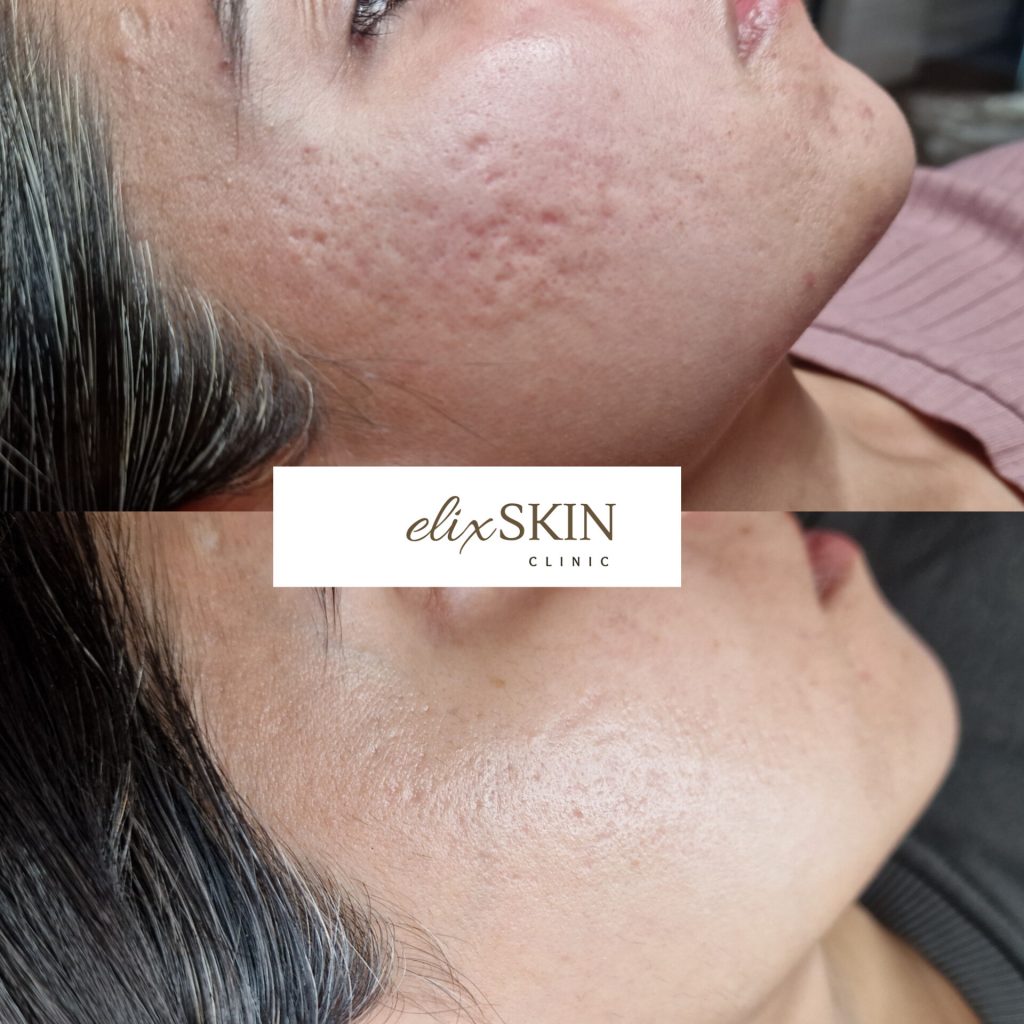
How Does Laser Treatment Work for Acne Scars?
Laser treatment for acne scars works by creating controlled damage to the skin, triggering the body’s wound healing response and stimulating new collagen production. There are two main categories: ablative and non-ablative lasers.
Ablative lasers (such as CO2 and Erbium) vaporise thin layers of skin tissue. The most common is the fractional CO2 laser, which creates thousands of microscopic columns of injury while leaving surrounding tissue intact. As the skin heals, it produces new collagen and regenerates with improved texture.
Non-ablative lasers heat the underlying dermis without removing surface tissue. They stimulate collagen production with less dramatic results but significantly less downtime. Common examples include the 1550nm Erbium-doped and 1064nm Nd:YAG lasers.
The theory is straightforward, by removing or heating damaged scar tissue and prompting collagen remodelling, the skin’s texture improves. In practice, results vary considerably depending on scar type, depth, skin tone, and individual healing capacity.
Is Laser Treatment Effective for Acne Scars?
Research shows that laser treatments can meaningfully improve acne scarring—but the degree of improvement is often more modest than marketing suggests.
A study published in the Indian Journal of Dermatology found that after three to four sessions of fractional CO2 laser, 43% of patients achieved “excellent” response (over 50% improvement) while 25% achieved “good” response (25-50% improvement). However, 32% of patients showed poor response with less than 25% improvement. The NHS Bristol Laser Centre states that studies show “30-50% improvement in acne scarring from a single treatment, but results vary between individuals.”
These figures reveal an important truth that laser treatment helps most people to some degree, but roughly one-third see minimal benefit despite multiple sessions and significant expense.
Which Scars Respond Best?
Not all acne scars respond equally to laser treatment. Research consistently shows that rolling scars (wave-like undulations caused by fibrous bands beneath the skin) and superficial boxcar scars respond best to fractional laser therapy. The PMC study specifically noted that “rolling and superficial boxcar scars responded the best while pitted scars responded the least to fractional laser monotherapy.”
Ice pick scars—those narrow, deep holes that extend far into the dermis—are notoriously resistant to laser treatment. The NHS explicitly states that CO2 laser “may not make much difference to deep ice-pick scars.” This is because laser resurfacing primarily addresses surface-level and mid-dermal tissue. When scars extend deeper, the laser simply cannot reach the problem area effectively.
This limitation is significant because ice pick scars are among the most common and psychologically distressing forms of acne scarring. Patients with predominantly ice pick scarring may undergo multiple expensive laser sessions only to find their deepest scars essentially unchanged.
Hyperpigmentation Risk for Darker Skin Tones
Perhaps the most significant limitation of laser treatment is its elevated risk profile for patients with darker skin tones. The melanin in darker skin absorbs laser energy more readily, which can lead to burns, post-inflammatory hyperpigmentation (PIH), or hypopigmentation (permanent lightening).
Research published in PMC found that “up to 92% of patients with Fitzpatrick skin type IV and higher develop PIH following ablative CO2 laser treatment.” A meta-analysis in PubMed examining adverse events in patients with Fitzpatrick skin types IV-VI found that post-inflammatory hyperpigmentation occurred at a rate of 8.1%—and this was for non-ablative treatments, which carry lower risk than ablative lasers.
The MDedge Dermatology journal states plainly: “Traditional approaches to treating acne scars (eg, dermabrasion, medium to deep chemical peels, CO2 laser resurfacing) are associated with a high risk for pigmentary and scarring complications in patients with skin of colour, especially those with Fitzpatrick skin types V to VI, and therefore are not generally recommended in this patient population.”
For patients with darker skin—which includes many people of South Asian, Middle Eastern, African, and Mediterranean heritage—laser treatment is not necessarily off the table, but it requires extreme caution, conservative settings, and practitioners with specific expertise in treating skin of colour. Even then, complications remain more likely than in lighter-skinned patients.
How Many Laser Sessions Are Needed?
Laser treatment for acne scars is not a one-and-done procedure. Most patients require multiple sessions to achieve optimal results, with treatments typically spaced four to eight weeks apart for non-ablative lasers or up to six months apart for ablative CO2 treatment.
The general guidance is three to six sessions for meaningful improvement, though this varies by scar severity and laser type. The Bristol NHS Laser Centre notes that “one to three treatment sessions may be required, with six months between sessions” for fractional CO2 treatment.
Each session costs £300-1,200 depending on the laser type and clinic, meaning a full treatment course can easily reach £1,500-3,600 or more. When ice pick scars fail to respond and additional combination treatments become necessary, costs escalate further.
Downtime and Recovery
Ablative laser treatment involves significant downtime that many patients underestimate. The NHS Bristol describes the immediate aftermath: “Your skin will look and feel like moderate sunburn. It may be swollen and slightly oozy for 24 hours. After this the skin surface will peel for three to seven days. The skin will heal in about seven days and may look pink for another three to six weeks.”
Their practical advice: “You should be prepared to take a week off work, contact sports, and swimming.”
For patients who cannot afford extended time away from work or social commitments, this downtime presents a significant barrier. Non-ablative lasers offer reduced recovery time but typically deliver less dramatic results.
Laser Treatment Costs in the UK
Laser treatment for acne scars represents a substantial financial investment. Current UK pricing typically falls within these ranges:
| Laser Type | Cost Per Session | Sessions Needed | Total Estimate |
|---|---|---|---|
| Fractional CO2 (NHS Bristol) | £950 | 1-3 | £950-2,850 |
| Fractional CO2 (Private) | £400-1,200 | 3-5 | £1,200-6,000 |
| Non-ablative fractional | £300-600 | 4-6 | £1,200-3,600 |
| Erbium laser | £350-800 | 3-5 | £1,050-4,000 |
These costs exclude consultation fees (typically £50-200) and any additional treatments that may be recommended if laser alone proves insufficient.
It is worth noting that acne scar treatment is considered cosmetic by the NHS and is not routinely available on the health service. In rare cases where scarring causes significant psychological distress, referral may be possible—but most patients pursue private treatment. Understanding the full financial commitment before starting ensures you can complete the recommended course rather than stopping partway through due to cost concerns.
When Laser Treatment Falls Short
Given the limitations discussed, certain patient profiles are less likely to benefit from laser treatment:
Deep ice pick scarring: When scars extend deep into the dermis, surface resurfacing cannot adequately address them. These patients often require targeted treatments like TCA CROSS (applying concentrated acid directly into individual scars), punch excision, or regenerative approaches like PDRN that rebuild tissue from within.
Darker skin tones: The elevated risk of hyperpigmentation makes laser a higher-stakes gamble for patients with Fitzpatrick skin types IV-VI. While some practitioners specialise in treating skin of colour with modified protocols, the inherent risk remains.
Slow healers: Patients who heal slowly—whether due to genetics, nutritional deficiencies like low iron, or underlying health conditions—may not respond optimally to ablative treatments that rely on robust wound healing.
Previous unsatisfactory results: Those who have already tried laser without meaningful improvement may benefit from fundamentally different approaches rather than repeating the same modality.
Alternative Options to Lasers – PDRN (Specialist Scar Treatment)
For patients who cannot safely undergo laser treatment, or who have tried laser without success, PDRN (polydeoxyribonucleotide) offers an alternative mechanism of action.
Rather than destroying tissue to prompt regeneration, PDRN works by directly stimulating the skin’s repair processes. Derived from salmon DNA, PDRN contains nucleotide fragments that activate cellular repair pathways, promote collagen synthesis, and enhance blood vessel formation. Research in the Journal of Skin Stem Cell confirms that PDRN “reduces inflammation and supports collagen remodelling” in acne scar treatment.
At elixSKIN Clinic, our Specialist Scar Treatment approach combines PDRN micro-injections targeted directly into individual scars with full-face polynucleotide treatment. This dual method addresses both localised scarring and overall skin quality simultaneously.
Key advantages of PDRN over laser include safety for all skin tones with minimal hyperpigmentation risk, shorter downtime (typically 2-5 days versus 1-2 weeks), and effectiveness for patients who heal slowly or have not responded to other treatments. The treatment is particularly suited to ice pick and pitted scars where tissue volume has been lost, as PDRN rebuilds rather than resurfaces.
At approximately £375 per session with three sessions recommended (total ~£1,125), PDRN also represents a more accessible price point than multiple laser sessions.
Making the Right Choice
The question “does laser treatment work for acne scars?” cannot be answered with a simple yes or no. For the right candidate—someone with rolling or superficial boxcar scars, lighter skin, good healing capacity, and realistic expectations—laser can deliver meaningful improvement.
However, for patients with deep ice pick scars, darker skin tones, slow healing, or previous treatment failures, laser may not be the optimal choice. Understanding these limitations before committing to treatment prevents disappointment and wasted expenditure.
Frequently Asked Questions
Does laser treatment completely remove acne scars?
No treatment, including laser, can completely eliminate acne scars. The realistic goal is significant improvement—typically 50-70% reduction in scar visibility with optimal response. Some scarring will likely remain, though it should be considerably less noticeable.
How many laser treatments are needed for acne scars?
Most patients require three to six sessions for optimal results. Ablative CO2 laser sessions are typically spaced six months apart, while non-ablative treatments may be performed every four to six weeks. Your practitioner will recommend a treatment schedule based on your specific scarring.
Is laser treatment painful?
Ablative laser treatment is uncomfortable and often described as painful despite topical anaesthetic. The NHS recommends taking paracetamol or ibuprofen before treatment. Non-ablative lasers are generally more tolerable.
Can laser treatment make acne scars worse?
In rare cases, laser treatment can cause scarring complications or worsen hyperpigmentation—particularly in darker skin tones. This is why proper patient selection and experienced practitioners are essential.
What is the best laser for acne scars?
Fractional CO2 laser is considered most effective for deeper scars but carries more downtime and risk. Erbium lasers offer a gentler alternative. The best choice depends on your scar type, skin tone, and tolerance for downtime.
Is laser safe for dark skin?
Ablative laser carries elevated risks for Fitzpatrick skin types IV-VI. Non-ablative fractional lasers can be used more safely with conservative settings, but post-inflammatory hyperpigmentation remains a concern. Alternative treatments like PDRN may be preferable.
Finding the Right Treatment Path
Laser treatment can be an effective option for acne scars—but it is not the universal solution it is sometimes portrayed as. Understanding its genuine capabilities and limitations empowers you to make decisions that align with your specific circumstances.
If laser is suitable for you, ensure you choose a practitioner experienced with your skin type and scar pattern. If laser is not appropriate—or has already failed to deliver results—regenerative treatments like the Specialist Scar Treatment offer an evidence-based alternative worth exploring.
At elixSKIN Clinic , we specialise in a range of skin treatments designed to treat a number of skin concerns, from relaxation and a nice glow to Hyperpigmentation, Under Eye Dark Circles, Ageing Skin and Post Acne Scarring.
Have a look at our treatments and before and after images on Instagram.
To Book your next treatment visit us here.
Visit our website or get in touch to find out more about suitable treatments for you.