
Acne scars not responding to laser or other machine treatments: what is going on?
If you have had laser or microneedling for acne scarring and the results left you disappointed, please know that it does not mean your skin has failed. Acne scars not responding to laser or machine treatments is a frustration many people bring to a consultation, and the reason often lies in the scar itself rather than in anything you did or did not do.
This is exactly the situation our in-house protocol at elixSKIN Clinic was developed for. Post-acne scarring is our main specialism, and we work with clients who have had little to no results from treatments such as CO2, fractional, subcision or RF microneedling. Here is why that can happen, and what it may be worth thinking about before you spend more time and money.
Not all acne scars are the same
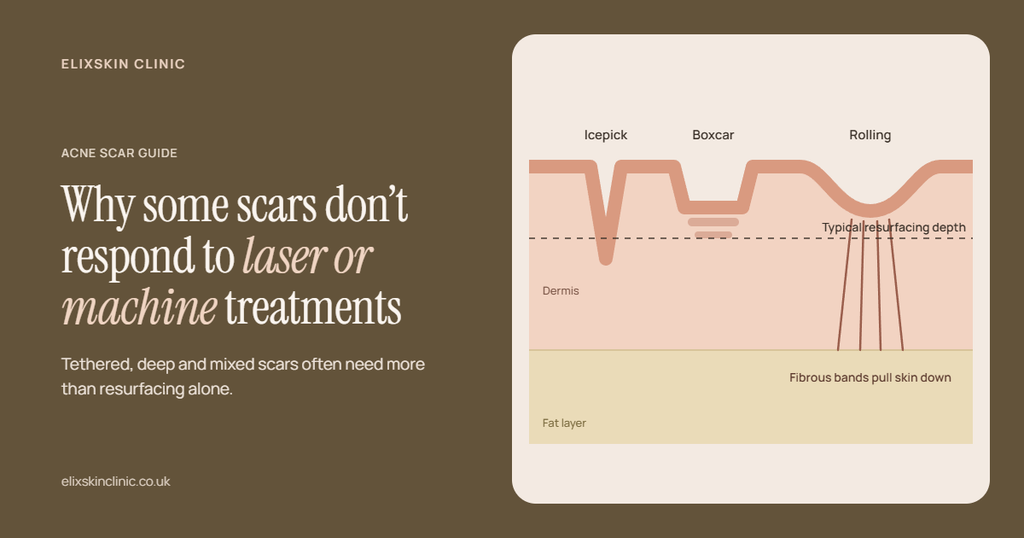
“Acne scarring” covers several different kinds of skin change. The NHS describes shallow holes in the skin such as ice-pick or boxcar scars, and many people also have broader, undulating rolling scars, plus areas of lingering colour change. Often someone has a mixture of all of these on one face.
Each type sits differently in the skin, with different depths, edges and attachments underneath. If you would like a closer look at the categories, our first post on understanding post-acne scarring types is a good place to start.
The key point is that a single device is rarely a perfect match for every scar on the face.
What lasers and machines are designed to do
Fractional lasers, CO2 lasers and microneedling devices all work in broadly the same way. They create controlled, tiny areas of injury so that the skin responds by remodelling itself. For some texture concerns, that may improve the appearance of the surface.
Fractional CO2 laser is often described as a first-line option for acne scarring, but clinical reviews also note that it can leave room for improvement. A Dermatology Times report discusses research into adding other approaches, such as subcision or radiofrequency, because they target different layers of scarring that laser alone may not reach.
In other words, even in the wider literature, combining approaches is a recognised idea. It is one reason a single course of the same treatment can plateau.
Why some scars may not respond
There is rarely one answer, but a few themes come up again and again.
The treatment does not match the scar. A scar that is anchored down by fibrous bands beneath the surface behaves differently from a shallow one. Energy applied to the surface may not release what is pulling the skin downwards.
Repeating the same treatment. If the first few sessions did little, more of the same does not always change the picture. The Dermatology Times article cites a review suggesting that side effects such as prolonged redness, swelling and, particularly in skin of colour, post-inflammatory hyperpigmentation may become more likely as the number of laser treatments rises.
Inflammation and pigment get in the way. Skin that is still reactive, or that has been left with colour change after treatment, can look worse before it looks better, and sometimes the pigment becomes the main concern.
Activity in the skin. Active breakouts can undermine results, which is one reason we think about treating acne and scarring in the right order. We will cover that in a future post.
Darker skin tones and the pigment risk
Lasers and energy-based devices need careful handling in deeper skin tones. Melanin absorbs light across a wide range, so there is a greater chance of triggering post-inflammatory hyperpigmentation, which is darkening of the skin after inflammation or injury.
A Healio report from the American Society for Dermatologic Surgery annual meeting quotes one dermatologist explaining that, with proper counselling and suitable settings, more intensive acne scar treatments can be used in skin of colour. The same piece stresses that clinicians should take a scarring history, get acne under control, and make sure sun protection is strict, and that some pigment change may still happen during healing.
A review in the American Journal of Clinical Dermatology also notes that post-inflammatory hyperpigmentation affects darker skin types most often and most severely, and that lasers remain a second-line option behind topical treatments for that concern.
Whatever your skin tone, it is worth asking any practitioner how they adapt their approach for it. We will look at this more closely in a post on hyperpigmentation and darker skin tones.
A different starting point
Because we see so many scars that have not responded to machines, we start by looking carefully at what your scars are doing rather than assuming that more energy is the answer.
We are not able to describe the protocol in detail here, and it would not be appropriate to promise any particular outcome. Every person’s skin is different, and results vary. What we can say is that a consultation is the place to talk through your history, what you have already tried, and whether there may be another approach worth exploring. Our Acne Scar Treatment page explains more about how the clinic works.
Questions worth thinking about before more treatments
Before you book another course of machine-based treatments, you might want to consider a few questions. What type of scars do I actually have? Why was this treatment chosen for them? What would we expect to see change, and over what period? What happens if it does not help? And how will my skin tone be taken into account?
If you are in the early stages of acne itself, the NHS advises seeing your GP when spots are deep, painful or causing scars, as they may prescribe stronger treatments or refer you to a dermatologist.
If you are a practitioner reading this, the clinic-led approach is what shapes our teaching at Elixir Skin Training. You can explore our regulated training options through our Ofqual-regulated qualifications, or see how to begin on our get started page.
Book a consultation at elixSKIN Clinic
If laser or machine treatments have not given you what you hoped for, we would be glad to talk. elixSKIN Clinic is at 6 Princess Road West, Leicester, LE1 6TP.
Visit elixskinclinic.co.uk or get in touch through our contact page. You can call us on 07399 983644 or email info@elixirskintraining.co.uk.
This article is general information, not individual medical advice. Booking a consultation is the right place to discuss your own skin.
